
Not every implementation story starts at the beginning. Sometimes a company arrives at the door of a new partner mid-crisis with a system already in place, a team already frustrated, and commissions that simply aren't calculating correctly. That's exactly where Alliance Consumer Group (ACG) found itself when they came to Canidium.
ACG had compensation software installed, plans built, and components configured. What they didn't have was a system that worked. The implementation they inherited from a previous partner had left the environment in poor shape; rules that didn't fire correctly, naming conventions that no longer matched the plans they were meant to serve, and a team without the knowledge or confidence to fix any of it on their own.
The system was in place. The commissions weren't calculating. And the team didn't know why.
Making the situation more complex was that ACG didn't want a long, drawn-out engagement. They had already been through one slow implementation experience. They weren't looking for another partner to take over and work in isolation; they wanted someone who would work with them, fixing problems in real time, explaining the logic as they went, and leaving ACG genuinely capable of managing the system themselves when it was over.
That meant Canidium had to adapt before the project even started.
The original plan called for a standard discovery phase: time to assess the environment, map the existing logic, and build a remediation roadmap. ACG needed immediate progress on reusing and repairing existing components, which meant pivoting instantly to hands-on working sessions without the typical preparatory runway.
Instead of a traditional engagement, Canidium shifted to real-time collaborative build sessions → fixing rules live, with the client in the room.
Those working sessions became the core of the engagement. Rather than Canidium disappearing to rebuild plans and returning with a finished product, the team worked through the logic together, identifying the specific rules that weren't firing, tracing the misleading naming conventions back to their source, and rebuilding the core plans and components side by side with ACG's internal team. When a rule was fixed, the client understood why it had been broken. When a new component was configured, the client knew how to replicate it.
The inherited technical debt was significant. Rules built by a previous partner carried names tied to legacy compensation structures that no longer existed, creating silent logic errors where a rule appeared to work but was calculating something entirely different than intended. Untangling that required careful investigative work on a system Canidium hadn't originally built, with no paper trail to follow.
The goal was not just to fix the system, but to make sure ACG never needed to call for help with the same problem twice.
Knowledge transfer was built into every session. By the time the remediation was complete, ACG's internal team understood the architecture of their own system, absorbing what the plans were doing, how the components connected, and what to look for if something broke again. Canidium provided basic troubleshooting training to anchor that understanding and leave the team genuinely self-sufficient.
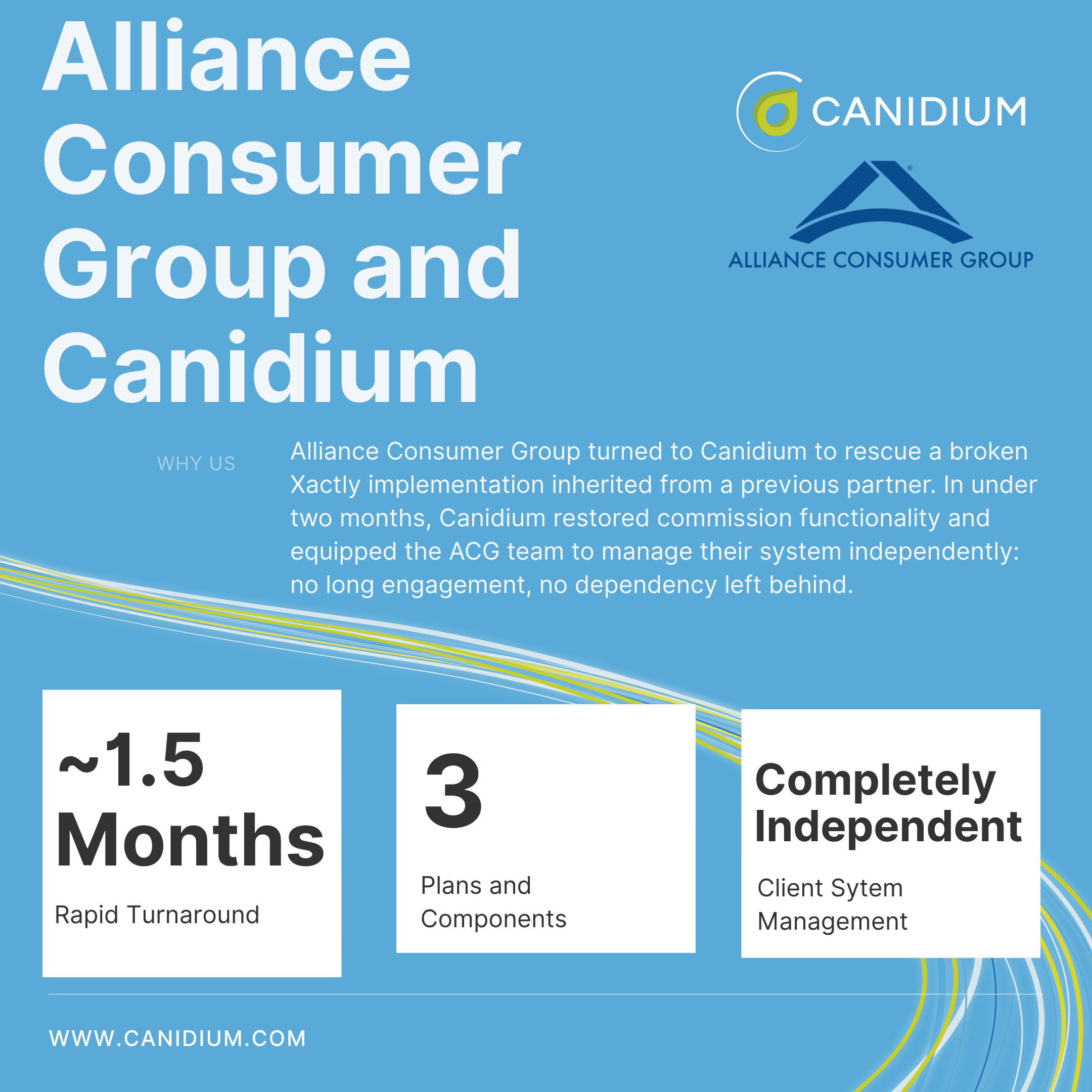
From start to finish, including remediation, testing, and troubleshooting, the entire engagement wrapped in approximately one to one and a half months. What ACG had feared would be a long, disruptive process turned out to be one of the fastest paths from broken to operational Canidium had delivered.
Canidium had done exactly what they set out to do: taught them how to be self-sufficient.
FAQ: Alliance Consumer Group and Canidium
1. Who is Alliance Consumer Group and what brought them to Canidium?
Alliance Consumer Group (ACG) is a consumer goods company that came to Canidium with a compensation system already in place but fundamentally broken. A previous implementation partner had left their Xactly environment with configuration errors, incorrect commission calculations, and naming conventions that created logic conflicts across their compensation plans. ACG needed a partner who could fix the system quickly and collaboratively without needing a lengthy re-implementation engagement.
2. What were the biggest challenges ACG faced?
- Inherited Technical Debt: The environment contained configurations from a previous partner that were not functioning correctly, causing commission calculations to fail.
- Misleading Naming Conventions: Legacy rule names had been repurposed for new compensation plans without being updated, creating logic errors where rules appeared active but were calculating the wrong values entirely.
- Urgency for Autonomy: ACG had a strong desire to become self-sufficient and reduce their reliance on external integrators. They didn't just want the system fixed, they wanted to understand it.
- Aversion to Long Engagements: Having already experienced a slow and ultimately unsuccessful prior implementation, ACG was wary of another drawn-out process and needed to see fast, tangible progress.
3. What technical barriers did the team encounter?
- Legacy Logic Without Documentation: Canidium's team had to untangle complex inherited rules they had not originally built, with no internal documentation to guide the forensic process.
- Immediate Process Pivot: Canidium had prepared for a standard discovery phase, but ACG needed to begin reusing existing components immediately. The team pivoted to active working sessions from the first engagement without the typical preparatory runway.
4. How did Canidium approach the engagement?
- Collaborative Build Sessions: Rather than working in isolation and delivering a finished fix, Canidium engaged in real-time rule-building sessions with ACG's internal team, enabling immediate feedback, correction, and client understanding at every step.
- Logic Remediation: The team identified the broken rules and mismatched naming conventions, rebuilding the logic for all 3 core plans and 3 components while preserving and reusing what was salvageable from the existing environment.
- Knowledge Transfer: Every fix was explained as it was made. Canidium provided basic troubleshooting training to ensure ACG's team understood both the root cause of the original issues and how to manage the system confidently going forward.
5. What were the results?
- Rapid Turnaround: The full remediation, including configuration, testing, and troubleshooting, was completed in approximately 1 to 1.5 months, far faster than ACG had anticipated when they first approached Canidium.
- Restored Commission Functionality: All non-working commission calculations were identified, rebuilt, and legitimized, delivering an immediate and concrete win for a client that had been operating with a broken system.
- True Client Independence: ACG achieved their core goal: self-sufficiency. The internal team left the engagement confident in their ability to manage, troubleshoot, and maintain their own compensation environment without relying on an external partner.
6. What technology was used?
- Xactly (compensation management platform)
- Canidium Advisory and Remediation Services
7. What makes this engagement different from a standard implementation?
Most Canidium case studies involve building something new. The ACG engagement was about rescuing something broken. That required a different skill set: forensic analysis of inherited logic, the ability to pivot methodology in real time, and a teaching-first approach to every fix. The goal wasn't to demonstrate Canidium's expertise, but to transfer that expertise directly to the client so that ACG walked away owning their system in a way they never had before.
8. Why should companies with broken or underperforming compensation systems choose Canidium?
- Proven ability to diagnose and remediate complex inherited configurations that Canidium did not originally build.
- Flexible, agile delivery methodology that adapts to client needs, including pivoting from discovery to active working sessions without losing momentum.
- Teaching-forward approach that prioritizes client understanding and independence alongside technical fixes.
- Track record of delivering fast, high-quality results even in high-pressure, time-sensitive remediation scenarios.
- Deep Xactly expertise that enables rapid identification of logic errors, naming conflicts, and configuration gaps.
Is your compensation system underperforming, or broken entirely?
Canidium specializes in getting compensation systems back on track quickly, and making sure your team has the knowledge to keep them there. Talk with an expert to explore what a remediation engagement could look like for your organization.