

Whether you're replacing your existing incentive compensation management software, or building your sales performance management infrastructure from scratch, selecting the right solution is paramount.
With each option, you need to evaluate:
- Can this compensation management system produce accurate payouts at scale?
- Can Finance trust and audit every number?
- Will it integrate cleanly into our architecture?
- Can it handle real-world plan complexity without constant intervention?
The quality of the sales compensation software you select will define how incentive plans operate as your business grows. With this in mind, here's our third-party experts in-depth guide to exploring the best-in-class sales performance and incentive compensation management software options.
The Myth of the "Best" Incentive Compensation Solution
You aren't looking for the "best" ICM software solution, because it doesn't exist. There is no singular solution that is ideal for every company. Instead, you are looking for the best solution for your organization's unique sales goals, incentive plans, commission calculations challenges, and existing infrastructure integrations (CRM systems/ERP ecosystems).
For example, a high-growth SaaS company with relatively standardized plans and a strong need for sales rep visibility may prioritize usability, speed, and transparency. On the other hand, a global enterprise operating sales teams across multiple regions, currencies, and compensation plan regulatory environments will prioritize auditability, scalability, and integration with financial systems. Both organizations need incentive compensation software, but they do not need the same ICM solution.
The same principle applies to complexity. Some platforms are optimized for rapid deployment and ease of use, which makes them highly effective in environments with moderate sales planning complexity and limited IT involvement. Others are designed to model highly complex compensation structures and integrate deeply into enterprise sales performance ecosystems, but require more upfront design and governance to operate effectively. Neither is inherently better, they are built for different operating realities.
This is why the most important question is not “Which platform is best?” but rather:
“Which platform is best suited to how our organization actually operates, and how it will need to operate in the future?”
How to Evaluate Incentive Compensation Platforms (The Right Way)
Before comparing vendors, it’s important to anchor on what actually differentiates ICM software options in practice. Across hundreds of implementations, the gap between systems rarely comes down to surface-level functionality. Most modern platforms can calculate sales commissions.
The real differences emerge in how they handle:
- Complex crediting and hierarchies
- Audit trails and financial traceability
- Integration across CRM, ERP, and data systems
- Performance under scale and comp plan changes
This is why strong evaluations focus less on demos and more on use-case validation:
- Can the ICM software model your most complex incentive compensation plan without workarounds?
- Can it explain its automated calculations on every payout down to the transaction level?
- Can it adapt as your business outcomes evolve, not just as it exists today?
With all of these decision factors in mind, here's how the leading ICM software platforms compare.
SAP Incentive Management (SAP IM)
SAP Incentive Management is typically chosen by organizations that view incentive compensation as part of a broader enterprise architecture, not just a sales operations tool. Its core strength lies in its ability to handle scale, complexity, and financial rigor simultaneously.
Organizations operating across multiple regions, business units, and compensation models often require:
- Multi-dimensional crediting structures
- Complex hierarchies and rollups
- Alignment with financial systems and reporting standards
SAP IM is designed to operate in that environment. It provides:
- Highly configurable calculation logic capable of modeling complex plans
- Strong auditability with traceable calculations and version control
- Deep integration potential within SAP ecosystems and beyond
- The ability to support large, global organizations with evolving requirements
Pros, Cons, and Standout Elements
Where SAP IM stands out is not in simplicity, but in structural capability. It is built for organizations where incentive compensation must scale alongside finance, compliance, and enterprise data strategy. That said, this level of capability comes with tradeoffs.
SAP IM typically requires:
- More structured implementation and design upfront
- Strong governance to maintain long-term performance
- The right expertise to fully leverage its flexibility
For organizations with relatively simple plans or smaller teams, this can feel like more system than they need. But for organizations that have outgrown lighter-weight tools, it often becomes one of the few platforms capable of supporting their long-term requirements without workarounds.
Xactly Incent
Xactly is one of the most widely recognized platforms in the incentive compensation space and is often a strong fit for organizations looking for a balance between usability and capability.
It is particularly well-suited for:
- Sales-driven organizations with standardized compensation models
- Teams looking to move off spreadsheets or legacy systems
- Environments where time-to-value is a key priority
Xactly offers:
- Prebuilt frameworks for common compensation scenarios
- A user-friendly interface for Sales Ops and business users
- Faster deployment timelines compared to more complex enterprise platforms
Pros, Cons, and Standout Elements
Xactly performs particularly well in driving operational efficiency for mid-market to upper-mid-market organizations, especially those looking to move off spreadsheets or legacy systems and establish a more structured, automated approach to compensation management.
As organizations grow and their compensation structures become more sophisticated, there are a few areas that may require additional consideration.
- Highly customized hierarchies or crediting structures may require more intentional design and ongoing governance to keep them running smoothly.
- In more complex enterprise environments, deeper integrations may involve additional planning to ensure alignment across systems.
For many organizations, Xactly delivers a meaningful step forward in accuracy, visibility, and efficiency. As with any platform, the key is aligning its strengths with your operating model. For organizations with increasing complexity or global scale, taking the time to evaluate long-term fit upfront helps ensure the platform continues to support the business as it evolves.
Varicent
Varicent is known for its flexibility and analytical depth, particularly in environments where compensation design and sales commissions performance analysis are tightly connected.
It is often chosen by organizations that need:
- Advanced modeling capabilities
- Strong reporting and analytics
- The ability to simulate and optimize compensation plans
Pros, Cons, and Standout Elements
Varicent’s strength lies in its ability to handle complex logic and provide deep insight into compensation performance. This makes it a strong fit for organizations with:
- Sophisticated compensation strategies
- A need for ongoing plan optimization
- Heavy reliance on analytics and scenario modeling
However, that flexibility can introduce complexity. Organizations may encounter:
- Longer implementation timelines
- Higher reliance on technical expertise
- Increased effort to maintain and govern the sales performance management system over time
Varicent is often a powerful option, but one that requires alignment between technical capability and organizational maturity.
CaptivateIQ
CaptivateIQ has gained traction as a modern, flexible platform designed to improve usability and transparency, particularly for Sales Ops teams.
It is often positioned as:
- A more intuitive alternative to legacy systems
- A platform that balances flexibility with ease of use
- A strong option for organizations prioritizing visibility and collaboration
CaptivateIQ performs well in environments where:
- Transparency for reps and managers is critical
- Compensation plans are moderately complex
- Teams want faster iteration and less reliance on IT
Pros, Cons, and Standout Elements
Its strengths include:
- A clean, user-friendly interface
- Strong performance metrics reporting and visibility features
- Flexibility in modeling without heavy technical overhead
As organizations scale, however, some may encounter limitations:
- Extremely complex incentive compensation plan structures may push the boundaries of the platform
- Enterprise-level integration and governance requirements may require additional consideration
For many high-growth organizations, CaptivateIQ offers a compelling balance of flexibility and usability, but should be evaluated carefully for long-term scalability.
How to Choose Between Incentive Compensation Software
At this stage, the decision should not be based on which platform appears strongest overall. It should be based on which platform aligns most closely with your specific sales commissions operating model.
Organizations tend to find the best fit when they align platform strengths with their primary needs:
- If your priority is enterprise-scale complexity, financial alignment, and long-term structural capability, platforms like SAP Incentive Management often stand out
- If your priority is usability and faster time-to-value within a structured sales environment, Xactly may be a strong fit
- If your organization requires deep analytics and advanced modeling, Varicent may provide the flexibility needed
- If transparency, usability, and agility are key drivers, CaptivateIQ may align well
The most important factor is not where your organization is today, but where it is going.
Because switching incentive compensation systems is not something organizations do frequently. The platform you choose needs to support not just your current plans, but your future complexity.
Graphic prompting reader to reach out for a free evaluation and suggestion on platforms
This Decision Shapes More Than Compensation
Selecting an incentive compensation platform is not just a technology decision.
It defines:
- How quickly you can run payout cycles
- How confidently your teams trust compensation
- How effectively Finance can audit and report
- How well your systems scale with growth
At this stage, the goal is not to find the “best” platform. It is to find the platform that best aligns with your: scale trajectory, architectural complexity, governance requirement, and operational model
Because the wrong fit will recreate the same problems you set out to solve.
What to do Once You've Chosen an Incentive Compensation Management Solution
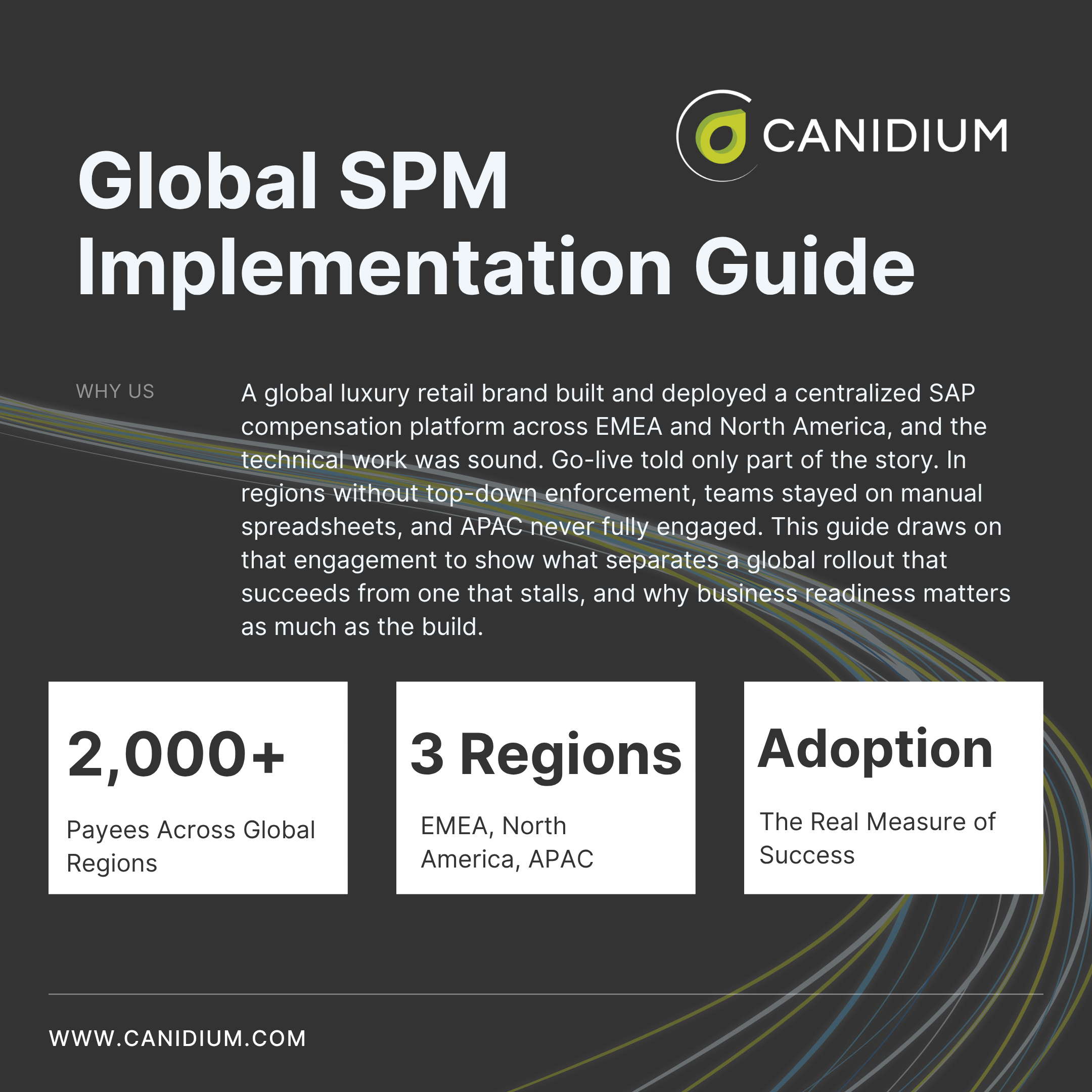
To make sure you are selecting the best fit for your organization’s unique needs, you need to truly understand the different options you have. Strong evaluations focus on outcomes: payout accuracy, audit traceability, scalability, integration depth, and the ability to handle real-world plan exceptions without breaking.
At this stage, you’re not just picking a tool, you’re choosing how incentives will operate as your business grows. If SAP incentive management seems like a good fit for you, the next step is to learn more about your costs and returns on a full solution implementation. Here’s the complete guide to replacing your existing ICM solution with SAP: