
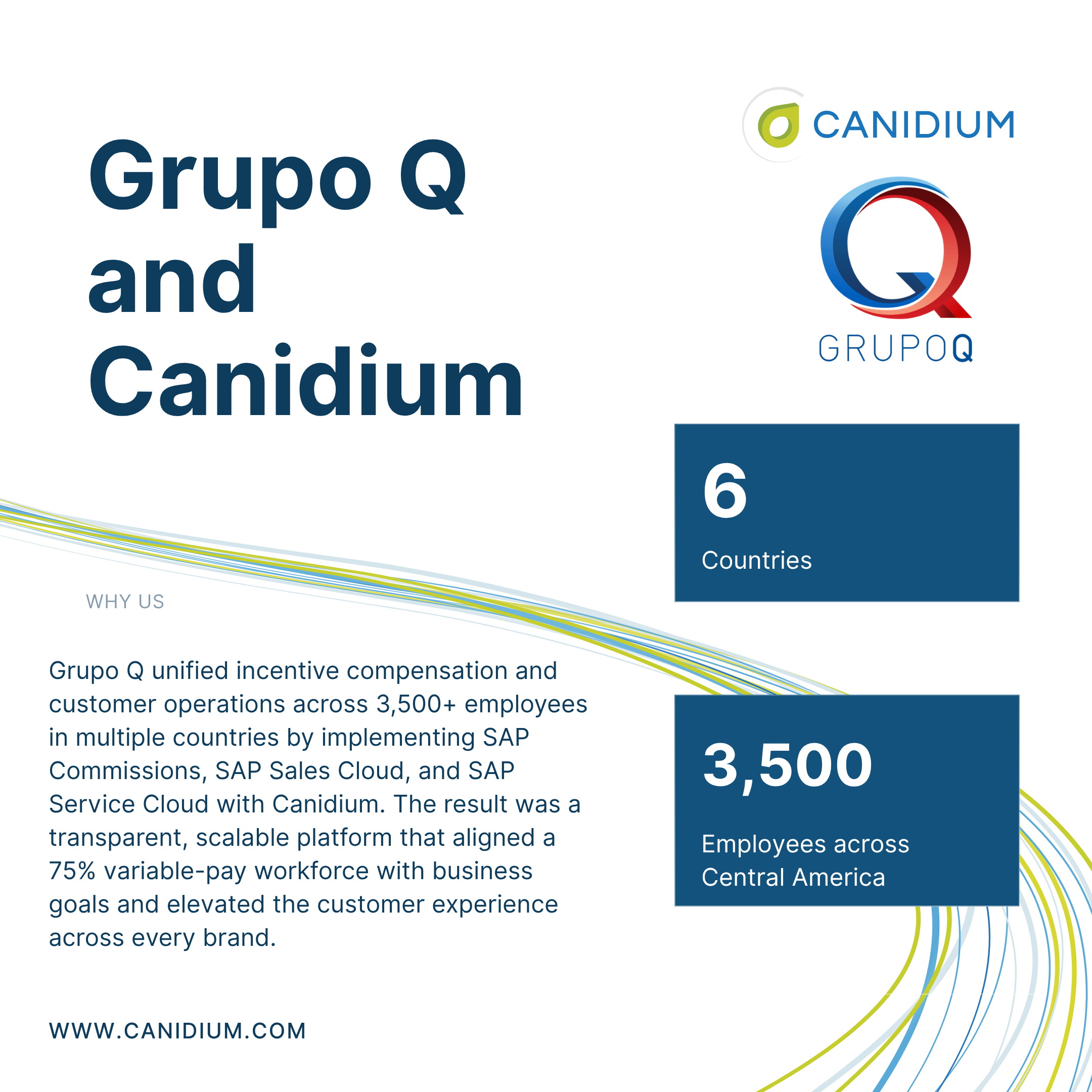

In Central America's competitive automotive distribution market, motivating a large and geographically dispersed workforce isn't just an HR challenge, it's a business-critical imperative. For Grupo Q, with more than 3,500 employees across six countries (Guatemala, Honduras, El Salvador, Nicaragua, Costa Rica, and Panama) and 75% of its workforce on variable compensation, the system responsible for driving that motivation was fundamentally broken.
Employees had no visibility into how their monthly earnings were calculated. Commission structures were opaque, fragmented by region, brand, and role, and disconnected from the performance metrics that actually mattered. When a service advisor couldn't answer the basic question "How does my effort translate into my pay?," disengagement followed. Morale dropped. Performance became inconsistent. And the problem compounded: fragmented customer data and manual, inefficient lead management across all six countries meant the customer experience was suffering too.
Internal teams had tried to fix it. Homegrown tools were built and abandoned. Each attempt fell short of what a multi-brand, multi-country operation at Grupo Q's scale actually required.
3,500+ employees across six countries. 75% on variable compensation. No clear way to see how their efforts translated into pay.
Leadership knew the problem demanded an enterprise-grade solution, rather than another workaround. That's when Grupo Q turned to SAP Commissions, SAP Sales Cloud, and SAP Service Cloud, with Canidium as their implementation partner.
SAP Commissions replaced a patchwork of disconnected calculations with a single platform integrated directly into Grupo Q's ERP, giving employees clear visibility into how their performance shaped their pay for the first time. SAP Sales Cloud unified lead management across all six countries, while SAP Service Cloud transformed post-sale customer engagement: automating sales orders, invoicing, and payments, and turning what had been a cost center into a profit center.
Canidium's approach was transparent, value-driven, and deeply collaborative. A phased rollout onboarded employee groups carefully across multiple divisions and countries, with roughly 50% of variable compensation recipients already live and expansion ongoing. When COVID-19 hit, Grupo Q's newly cloud-based infrastructure proved its worth, enabling remote operations that would have been impossible under the legacy systems left behind.
"Now, 75% of our workforce has a variable compensation scheme. Today, if you ask a service advisor how their variable compensation is structured, they can provide a clear answer. They understand how their efforts translate into commissions, leading to better alignment with business goals and customer service."
— Ronald Monterrosa, Director of Human Resources, Grupo Q
The results reached well beyond cleaner data and faster processing. Employees who understood their compensation became more engaged. Engagement drove better customer service. Better service elevated Net Promoter Scores. A more motivated, performance-aligned workforce contributed to measurable financial growth, with improved revenue and profit-per-employee metrics tied directly to the clarity and accountability the new system enabled. And the service department, once treated as a cost center, had been reframed entirely as a driver of profit.
What Grupo Q built with Canidium wasn't just a commission tool or a CRM upgrade. It was an operating foundation, where transparency is the standard, every employee understands how their contribution matters, and customer and compensation data work together to drive a culture of excellence.
FAQ: Grupo Q, Canidium, SAP Commissions, SAP Sales Cloud, and SAP Service Cloud
1. Who is Grupo Q and why did they need Canidium's support?
Grupo Q is a leading automotive distributor operating across six Central American countries: Guatemala, Honduras, El Salvador, Nicaragua, Costa Rica, and Panama. With over 3,500 employees and approximately 75% of the workforce on variable compensation plans, the company needed a centralized, scalable solution to replace fragmented, homegrown commission tools that lacked transparency. At the same time, fragmented customer data and inefficient lead management across its multi-country dealership network were undermining customer experience and operational efficiency.
2. What were the biggest challenges Grupo Q faced?
- Opaque Commission Structures: Employees had no insight into how their monthly earnings were calculated, leading to confusion and distrust across a workforce that was majority variable-pay.
- Low Morale and Misalignment: Lack of compensation transparency drove disengagement and inconsistent individual and team performance.
- Failed Internal Systems: Multiple attempts to build in-house commission management tools fell short of the complexity Grupo Q's multi-brand, multi-country plans required.
- Fragmented Customer Data: Customer information lived in silos across six countries, with no unified view of interactions, leads, or service history.
- Inefficient Lead Management: Manual workflows for sales orders, invoicing, and lead tracking slowed teams and created gaps in the customer experience.
- Scaling Across Geographies: Any solution needed to accommodate significant regional and role-based variation while remaining unified at the enterprise level.
3. What technical barriers did Grupo Q encounter?
- Disconnected Compensation Logic: Commission data lived in silos with limited automation and unclear attribution between employee performance and pay outcomes.
- Legacy System Limitations: Existing systems had limited API capabilities, complicating real-time data integration with SAP and other platforms.
- Complex Variable Compensation Rules: Translating diverse compensation plans across multiple vehicle brands, service lines, and regions into a single automated system required significant configuration expertise.
- Multi-Country Onboarding Complexity: Managing employee onboarding across multiple divisions, languages, and regulatory environments added substantial implementation complexity.
- Lack of Real-Time Visibility: Neither leadership nor employees had timely access to the data needed for operational decisions or performance adjustments.
4. How did Canidium partner with Grupo Q?
- Led strategic planning and solution design for SAP Commissions, SAP Sales Cloud, and SAP Service Cloud across the full enterprise.
- Executed end-to-end implementation integrated with Grupo Q's existing ERP environment, enabling real-time process tracking across sales and service operations.
- Provided transparent, professional, and personalized advisory services that built trust with Grupo Q's leadership; a critical factor given the company's history of failed internal development attempts.
- Managed a phased rollout strategy that carefully onboarded diverse employee groups without disrupting ongoing operations across six countries.
5. What solutions were implemented and what was the impact?
- Centralized Compensation Platform: SAP Commissions replaced fragmented systems, giving each employee a clear view of their goals, payment structure, and performance impact on compensation.
- Intelligent Sales Automation: SAP Sales Cloud unified lead management and sales workflows across all six countries, replacing manual processes with automated, trackable pipelines.
- Enhanced Customer Service Operations: SAP Service Cloud transformed post-sale customer engagement, enabling the service department to evolve from a cost center into a profit center.
- Real-Time ERP Integration: SAP Sales Cloud and SAP Service Cloud were integrated directly with Grupo Q's ERP, automating sales orders, invoicing, and payments.
- Phased Rollout: Approximately 50% of variable compensation recipients are already live on SAP Commissions, with continued expansion planned across additional business units.
- Cloud-Based Resilience: The shift to cloud-based infrastructure enabled Grupo Q to maintain full business continuity and remote operations during COVID-19.
6. What measurable results did Grupo Q realize?
- Increased NPS: Improved customer service outcomes driven by more motivated, better-aligned employees and more efficient service operations.
- Improved Workplace Climate: Employees now understand how their individual contributions impact their compensation, improving trust and morale company-wide.
- Financial Growth: Enhanced revenue and profit-per-employee metrics attributed in part to increased workforce clarity, engagement, and operational efficiency.
- Service Department Transformed: The service department shifted from a cost center to a profit center as a result of improved processes and customer engagement.
- Operational Efficiency Gains: Automated workflows for sales orders, invoicing, and payments replaced manual processes, freeing teams to focus on higher-value work.
- COVID-19 Business Continuity: Cloud-based systems enabled the company to operate remotely and maintain normal operations during the pandemic.
7. What technologies were used?
- SAP Commissions (Callidus module)
- SAP Sales Cloud
- SAP Service Cloud
- Grupo Q ERP System (real-time integration)
- Canidium Advisory and Implementation Services
8. What role did the employee experience play in this transformation?
At the center of Grupo Q's challenge was not just a technology problem, it was a people problem. When employees can't understand how they're compensated, trust erodes and performance suffers. By making compensation transparent and directly connecting pay to measurable goals, Grupo Q rebuilt that trust at scale across a workforce of more than 3,500 people spanning six countries. The result was a workforce that felt seen, understood, and motivated to perform; and that motivation translated directly into better customer outcomes.
9. Why was the phased rollout approach important?
A multi-country operation with diverse regional compensation structures, multiple vehicle brands, and legacy system dependencies can't execute a system-wide change overnight without significant risk. The phased approach allowed Grupo Q to onboard business units in sequence, gather feedback, and refine the implementation before expanding, protecting business continuity while building employee and leadership confidence in the new platform at each stage.
10. Why should companies with complex, distributed workforces choose Canidium?
- Proven expertise in SAP Commissions, SAP Sales Cloud, and SAP Service Cloud implementations across diverse industries and geographies.
- Advisory-first approach that goes beyond deployment to drive real adoption, cultural alignment, and long-term value.
- Deep experience managing multi-country, multi-brand, multi-plan compensation and customer operations environments.
- Transparent, trust-based partnership style that earns credibility with both leadership and frontline teams, especially critical when organizations have experienced prior implementation failures.
- Track record of connecting compensation transparency and operational efficiency to measurable business performance outcomes.
Ready to bring clarity, alignment, and performance to your compensation and customer operations?
Talk with a Canidium expert to explore how SAP Commissions, SAP Sales Cloud, and SAP Service Cloud can transform how your workforce operates, and how your customers experience your brand.