
In today’s fast-paced business environment, the performance of Configure, Price, Quote (CPQ) systems isn’t just about convenience—it’s about competitiveness. Slow CPQ processes drain efficiency, frustrate sales teams, and can directly impact customer satisfaction and deal velocity.
One global client faced exactly this challenge. Their CPQ system was plagued by sluggish performance: adding a single product to a quote took nearly 50 seconds, and editing products or selecting attributes was equally painful. These delays didn’t just waste time—they slowed down sales cycles and eroded user confidence.
50 seconds to add a product, 15 seconds to edit, 2 seconds for every attribute change—inefficiencies that killed productivity.
The mandate was clear: streamline performance, eliminate bottlenecks, and ensure sales teams could deliver quotes at speed without sacrificing accuracy.
That’s when the client turned to Canidium. Our consultants dug deep into the CPQ developer console, uncovering hidden inefficiencies—from unnecessary event triggers to redundant calculations and excessive quote saves. Each issue was systematically addressed, optimized, or eliminated.
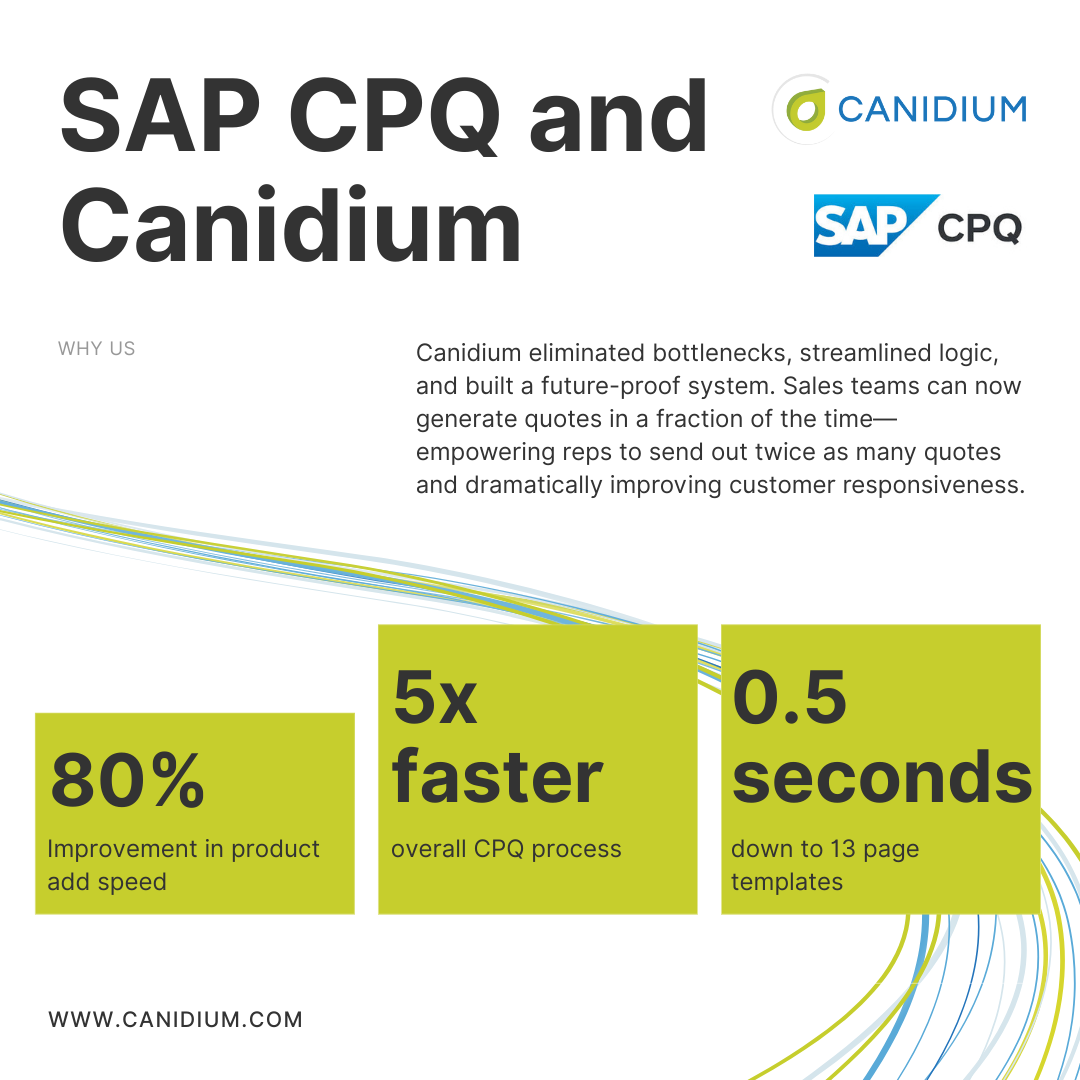
The transformation was remarkable. Adding a product dropped from 50 seconds to under 10 seconds—an 80% improvement. Editing time was cut in half, and attribute selection became so fast the delay was imperceptible.
“What once frustrated reps became seamless. With faster CPQ, teams could send out twice as many quotes as before.”
The result wasn’t just speed—it was a CPQ system rebuilt for scalability, sustainability, and future growth.
FAQ: Canidium and CPQ Performance Optimization
1. What were the client’s biggest performance challenges?
- Adding a single product to a quote took ~50 seconds.
- Editing a product required ~15 seconds.
- Attribute selection lagged by ~2 seconds per change.
- Excessive background saves and redundant calculations bogged down the process.
- Salesforce (SFDC) integration created delays through duplicate calls.
2. What technical bottlenecks were uncovered?
- Unnecessary event triggers firing scripts that slowed processes.
- Excess quote saves running multiple times instead of once.
- Redundant cart calculations for discounts and pricing.
- Redundant SFDC calls instead of batched updates.
- 8–10 product scripts needing consolidation into one.
- Inefficient loops and SQL calls in scripts.
3. How did Canidium identify and prioritize bottlenecks?
- Used the CPQ developer console with added temporary logs to analyze functions.
- Identified where system resources were wasted and targeted the biggest slowdowns first.
4. Were there trade-offs between speed and functionality?
No. Functionality remained identical, while calculations became simpler and easier to maintain.5. How future-proof were the optimizations?
- Strategies simplified core processes, making the system easier to extend and scale.
- Performance regressions remain a risk if best practices aren’t followed, but Canidium built a structure to sustain performance.
6. What organizational changes were recommended?
- Include performance checks in the Definition of Done (DoD) for all new features.
- Ensure development teams adopt best practices consistently to prevent regressions.
7. What measurable results were achieved?
- Adding a product: cut from ~50 seconds → under 10 seconds (80% faster).
- Editing a product: cut from ~15 seconds → 8 seconds.
- Attribute selection: cut from ~2 seconds → 0.5 seconds, effectively instant.
- Overall, more than 5x faster CPQ performance.