
Skip to content
Menu

SHARE

If you're working with misconfigured pricing software, odds are that the system broke down slowly and quietly over time. At first, it’s small things; an uptick in sales reps asking for exceptions to the built-in pricing strategy, or finance questioning a margin number in a forecast. Over time, approvals start taking longer than they used to, and teams export data into spreadsheets because it’s easier.

Then eventually, the workarounds become the process.

Sales stops trusting pricing strategy guidance. Finance loses visibility into price management and profitability. IT becomes buried in urgent fixes and one-off requests. Pricing managers and teams spend more time managing friction than driving strategy.

This is one of the most common patterns organizations experience if their enterprise pricing software is not configured to meet the current needs of the business. Systems evolve alongside the business—but not always in a controlled or sustainable way. The result is a pricing environment that becomes increasingly difficult to trust, maintain, and scale.

The good news is that most pricing software and infrastructure problems can be fixed. Here's how:

Start By Pinpointing The Problem Within Your Pricing Software Configuration

Beginning The Diagnostic Process: How to Spot and Treat Misconfigurations in Price Optimization Software

The Real Solution: A Technical Health Check

What a Strong Technical Health Check Actually Looks At


Start By Pinpointing The Problem Within Your Pricing Software Configuration

One of the hardest parts about diagnosing dynamic pricing software problems is that the symptoms often look like people or process problems instead of technology problems. Leadership might see increasing discount levels, slower quote turnaround times, margin inconsistency, forecasting volatility, or escalating approval requests.

At the same time, sales teams might experience confusing pricing strategy guidance, approval fatigue, inconsistent deal outcomes, and frustration with rigid price management workflows.

Meanwhile, all of these problems are downstream from what IT and Pricing Ops are usually seeing:

5 Signs You Have a Problem Within Your Pricing Software Configuration

Everyone feels the friction differently. But in many cases, they’re all reacting to the same root issue: the pricing infrastructure no longer reflects how the business actually operates.


Understand Why Dynamic Pricing Software Becomes Misaligned Over Time

Most dynamic pricing engines are not static systems. They evolve constantly. New products get added. Customer segments shift. Acquisitions happen. Pricing strategies mature. Approval structures change. Market conditions fluctuate.

But many organizations never revisit the underlying architecture supporting those changes. Instead, they layer modifications onto the existing environment, such as:
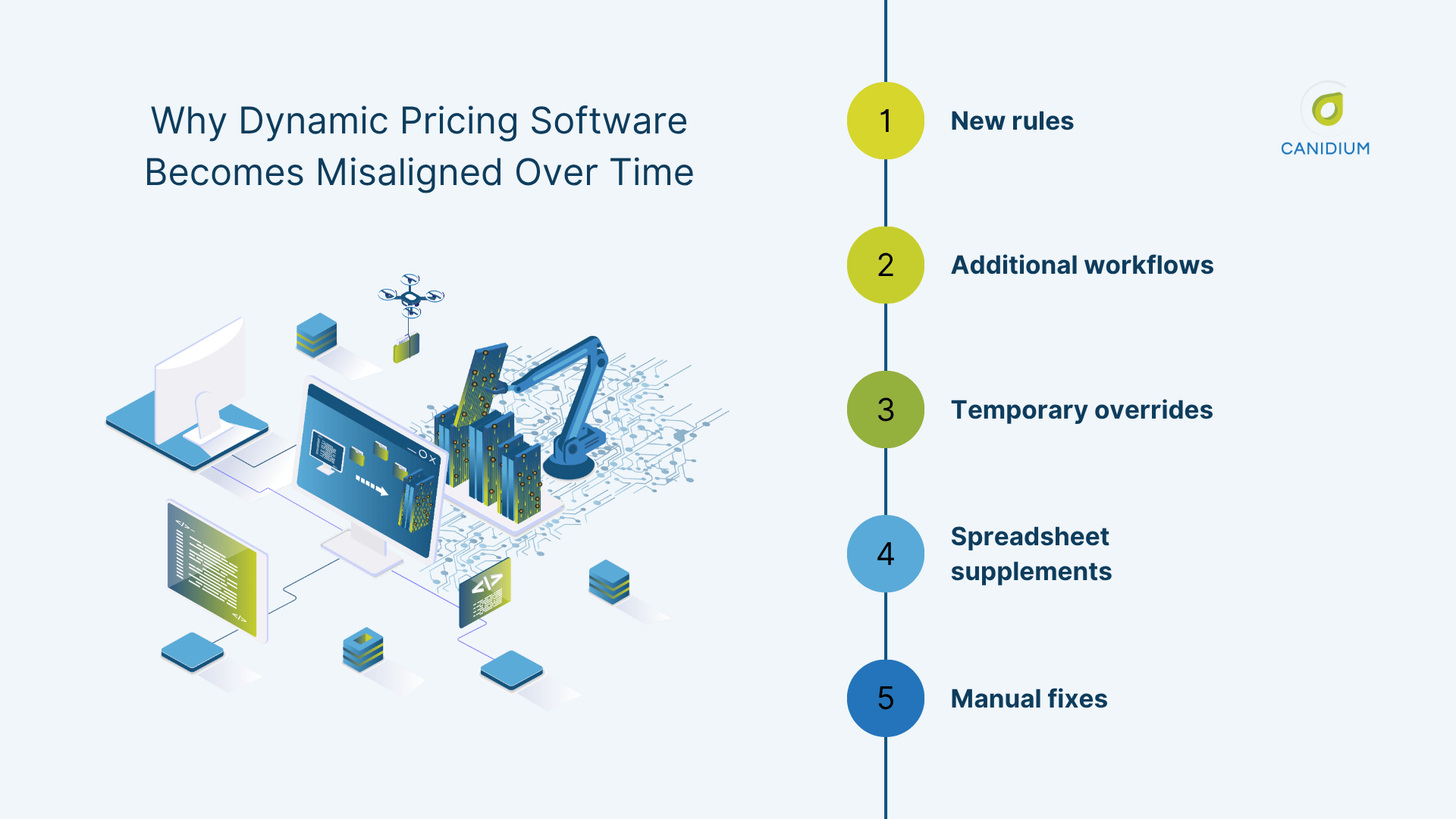
Why Dynamic Pricing Software Becomes Misaligned Over Time

Over time, the system becomes increasingly complex without becoming more effective. Our pricing software experts find that enterprise software environments consistently show the same patterns:

  • The majority of long-term system instability comes not from the original implementation, but from years of unmanaged incremental change
  • Technical debt compounds when organizations prioritize short-term fixes over architectural alignment
  • Highly configurable systems create enormous flexibility—but also require ongoing governance and optimization to remain healthy

This is especially true in pricing environments because price management touches nearly every revenue-critical process in the organization.


Beginning The Diagnostic Process: How to Spot and Treat Misconfigurations in Price Optimization Software

The problem is that internal teams often adapt to this complexity gradually. Workarounds become normalized. Fragile processes become routine. Institutional knowledge replaces documentation.

Eventually, nobody fully understands the system anymore, not because teams lack capability, but because the environment has evolved beyond what any one department can fully see.

That’s why external pricing software specialists are often necessary. They can evaluate the environment without inherited assumptions, identify structural risks internal teams may overlook, and benchmark your pricing infrastructure against broader industry best practices and platform-specific expertise.

The specific issues within your price optimization infrastructure will be unique to your organization. However, to help you start the diagnostic process, here are some common challenges that plague many enterprise pricing software systems and how to tell if you need Technical Health Check (THC) experts:

1. Deal Approvals Keep Escalating

If pricing approvals increasingly require leadership intervention, it often means the system’s pricing logic no longer reflects market reality.

This usually happens because:

  • Approval thresholds are outdated
  • Segmentation models no longer fit customer behavior
  • Margin guardrails for price points are too rigid
  • Sales teams don’t trust system recommendations from the price optimization software

When this happens, approvals stop being governance tools and become operational bottlenecks. The reason organizations struggle to fix this internally is because approval friction rarely originates from just one workflow rule. It’s usually tied to interconnected pricing logic, outdated segmentation models, historical implementation decisions, and evolving sales behavior patterns.

If you don't have a specialist in your specific pricing software configuration on your team, it's generally recommended to contract a configuration and implementation expert to help with this process.

Third-party pricing experts can identify where the breakdown actually starts. Because they’ve seen similar approval bottlenecks across multiple environments, they can quickly distinguish between:

  • A workflow issue
  • A pricing strategy issue
  • A configuration issue
  • A data issue
  • Or a combination of all four

Without that outside perspective, organizations often keep tightening approval policies instead of fixing the underlying architecture, causing the escalations.

2. Pricing Logic Feels Opaque

One of the clearest warning signs that your revenue management infrastructure is misconfigured presents as a knowledge gap. In other words, nobody can fully explain why the system produced a certain price.

Sales doesn’t understand the recommendation. Finance questions the margin calculation. IT struggles to trace the logic path. Pricing Ops relies on institutional knowledge from one or two key employees.

This is often the result of:

  • Layered customizations
  • Poor price optimization documentation
  • Complex rule dependencies within the price optimization software
  • Historical configuration decisions within ERP systems integrations that were never revisited

Once pricing logic becomes opaque, trust begins to erode across the organization. This is one of the strongest indicators that outside expertise is needed.

Internal teams are often too close to the environment. Over time, employees adapt to confusing logic and undocumented processes simply because they’ve lived with them for years. But experienced pricing software consultants know how to reverse-engineer pricing environments systematically. They understand how pricing rules interact across workflows, integrations, approvals, and analytics layers.

More importantly, they can identify:

  • Hidden dependencies
  • Conflicting rules
  • Redundant customizations
  • Legacy logic is no longer aligned with the current pricing strategy

Without that deep platform expertise, organizations often continue building new logic on top of broken foundations, making the environment even harder to maintain.

3. Manual Workarounds Are Everywhere

Spreadsheets are often the first sign that pricing software and revenue management infrastructure is compensating for deeper structural problems. Teams start manually:

  • Adjusting quotes generated by machine learning and AI
  • Tracking exceptions
  • Reconciling pricing and sales data
  • Calculating margins
  • Managing approvals and price execution outside the system

These workarounds may seem harmless at first. But they create fragmented processes, inconsistent data, and growing operational risk.

Eventually, the organization ends up maintaining two systems: the official platform and the unofficial manual process everyone actually relies on. The challenge is that internal teams often become dependent on these workarounds. They stop viewing them as temporary fixes and start treating them as part of normal operations.

Third-party specialists can spot where manual effort is masking deeper infrastructure failures.

Because they’ve worked across multiple pricing environments, they know which activities should be automated, which processes indicate architectural misalignment, and where operational friction is unnecessarily consuming time and margin.

An experienced pricing consultant can often identify inefficiencies that internal teams no longer notice simply because they’ve become part of everyday work.

4. System Changes Feel Risky

In healthy pricing software environments, teams can adjust logic confidently. In unstable environments, even small changes create fear. Organizations become hesitant to:

  • Modify pricing rules based on market data
  • Introduce new products to meet market trends
  • Adjust workflows
  • Update integrations

This usually points to brittle architecture and accumulated technical debt because nobody fully understands the downstream impact of changes anymore.

This is another area where outside expertise becomes essential. When internal teams lose confidence in making changes, it usually means the system has become too interconnected, and sales data is too poorly documented to safely manage without specialized analysis.

Third-party pricing experts can map dependencies across the environment and identify:

  • Which components are stable
  • Which customizations introduce risk
  • Which integrations are fragile
  • Which areas can be safely optimized first

Without that structured analysis, organizations often avoid necessary improvements entirely because the perceived implementation risk feels too high.

5. Reporting and Analytics Are Inconsistent

When Sales, Finance, and Pricing teams all report different numbers, the issue is rarely reporting alone. It’s usually rooted in:

  • Data inconsistencies across systems
  • Misaligned calculations
  • Weak integrations
  • Duplicate logic across platforms

At that point, decision-making slows because teams stop trusting the data. And without trusted pricing analytics and customer data, optimization becomes almost impossible.

These problems are particularly difficult to diagnose internally because reporting inconsistencies are often symptoms of larger structural data problems spread across multiple systems.

Pricing software specialists understand how pricing data flows between CRM, ERP, analytics, pricing, and CPQ software. They know where mismatches typically occur and how seemingly minor configuration issues can create widespread reporting inaccuracies downstream. Most importantly, outside experts can objectively evaluate whether the organization’s reporting problems stem from:

  • Data quality
  • Integration failures
  • Calculation logic
  • Workflow design
  • Platform configuration
  • Or broader governance gaps

Without that platform-specific expertise, organizations often spend enormous amounts of time debating which numbers are correct instead of fixing the infrastructure causing the inconsistencies in the first place.


Why You Can't Fix Misconfigured Software With Process Changes

One of the biggest mistakes organizations make is trying to solve structural pricing software problems with more policy enforcement. They add:

  • More approval layers
  • More governance meetings
  • More spreadsheet checks
  • More manual reviews

But that rarely addresses the underlying issue. If the infrastructure itself is misaligned, tightening the process simply increases friction without improving outcomes.

The problem isn’t that employees aren’t following the process. The problem is that the process has become disconnected from the system supporting it.


The Real Solution: A Technical Health Check

If the problems identified in this article sound familiar, you need a structured diagnosis. 

A Technical Health Check is designed to uncover:

  • Where pricing logic is breaking down within your dynamic pricing engine
  • Which workflows create unnecessary friction in price execution
  • Where integrations are failing to drive revenue growth
  • Which customizations are creating instability
  • How pricing architecture and artificial intelligence align, or misalign, with current global pricing operations

Most importantly, it helps organizations distinguish between cosmetic, operational, and structural problems. Because not every issue requires a major rebuild. 

In many cases, a targeted set of optimizations can dramatically improve:

  • Pricing agility
  • User trust
  • Approval speed
  • Margin visibility
  • Reporting accuracy
  • System maintainability

Why Technical Expertise Alone Isn’t Enough

This is especially important in highly configurable platforms like dynamic pricing software. Pricing environments are incredibly powerful, but also incredibly nuanced.

The slightest misconfiguration during implementation can create ripple effects throughout:

  • Approval workflows
  • Discount logic
  • Data integrations
  • Dynamic pricing models
  • Reporting structures

And because pricing touches so many interconnected systems, diagnosing issues requires more than technical platform knowledge. It requires understanding:

  • Revenue operations
  • Pricing strategy
  • Sales workflows
  • Financial governance
  • Organizational behavior
  • Data architecture

That’s why effective health checks are rarely performed by generalist consultants alone.

They require specialists who understand both the technical foundation and the operational reality of enterprise pricing environments.


What a Strong Technical Health Check Actually Looks At

A comprehensive pricing system assessment typically evaluates several core areas.

Pricing Logic and Rule Structure

Teams assess whether pricing rules are aligned with the current strategy, whether approval thresholds still make sense, and whether the logic is maintainable and scalable over time.

Workflow and Approval Architecture

Organizations examine where deals are slowing down, which approvals genuinely add value versus friction, and whether workflows align with real sales and customer behavior instead of idealized process maps.

Integration and Data Quality

A health check also evaluates whether ERP, CRM, and pricing systems are synchronized properly, whether data on competitor prices is timely and trustworthy, and where inconsistencies are introduced into the pricing process.

Reporting and Analytics

Teams determine whether stakeholders can confidently trust pricing outputs, whether calculations are standardized, and whether reporting is actionable enough to support decision-making for

Technical Debt and Maintainability

Finally, organizations identify which customizations increase long-term risk, where architecture has become brittle, and how difficult future scaling or changes may become.


The Goal Isn’t Perfection. It’s Stability.

One of the biggest misconceptions about pricing optimization is that organizations need a “perfect” pricing system.

In reality, healthy pricing environments are simply:

  • Understandable
  • Adaptable
  • Governed
  • Trusted

The goal isn’t endless complexity. The goal is to create a pricing infrastructure that can evolve with the business without collapsing under its own weight.


Pricing Problems Are Often Infrastructure Problems

If deal approvals stall, discounts creep upward, or pricing logic feels opaque to both Sales and Finance, it’s a strong signal that the system, not the process, is failing. Pricing misconfigurations often hide in plain sight: outdated approval thresholds, inconsistent guardrails, or integrations that no longer reflect reality.

The next step isn’t more policy enforcement, but a structured assessment of where pricing logic breaks down and which fixes will have the greatest impact. Organizations that succeed start by mapping pricing pain points directly to system design gaps.

Pricing is a highly tailored, infinitely complex system. The slightest misconfiguration during your implementation project could have a ripple effect throughout your entire system. Pinpointing where your solution is going wrong is vital to getting maximal value out of your dynamic pricing capabilities, but it takes more than just technical expertise to get to the heart of the problem. You need to bring in specialists who know pricing software in and out to make sure you solve your pricing solution problems once and for all. In other words, you need a technical health check.
The Cost-Benefit Analysis of a Pricing System Health Check

Discover how optimizing pricing software can enhance profitability, reduce operational friction, and drive better decision-making in your organization.

Read Now

How to Diagnose and Fix Broken Pricing Infrastructure

Diagnose and fix misconfigured pricing software to restore trust, improve efficiency, and optimize revenue management across your organization.

Read Now

7 Signs Your Pricing Software Is Misconfigured (and What to Do About It)

Discover the signs of misconfigured pricing software and learn how to optimize it for better efficiency, user adoption, and profit margins.

Read Now

Cambia UAT Case Study

Cambia Health partnered with Canidium for a successful large-scale UAT, overcoming technical challenges and achieving rapid deployment of modernized producer management systems.

Read Now

Alliance Case Study

See how Canidium rescued Alliance Consumer Group's broken Xactly environment, fixing inherited commission errors and building client independence in under two months.

Read Now