
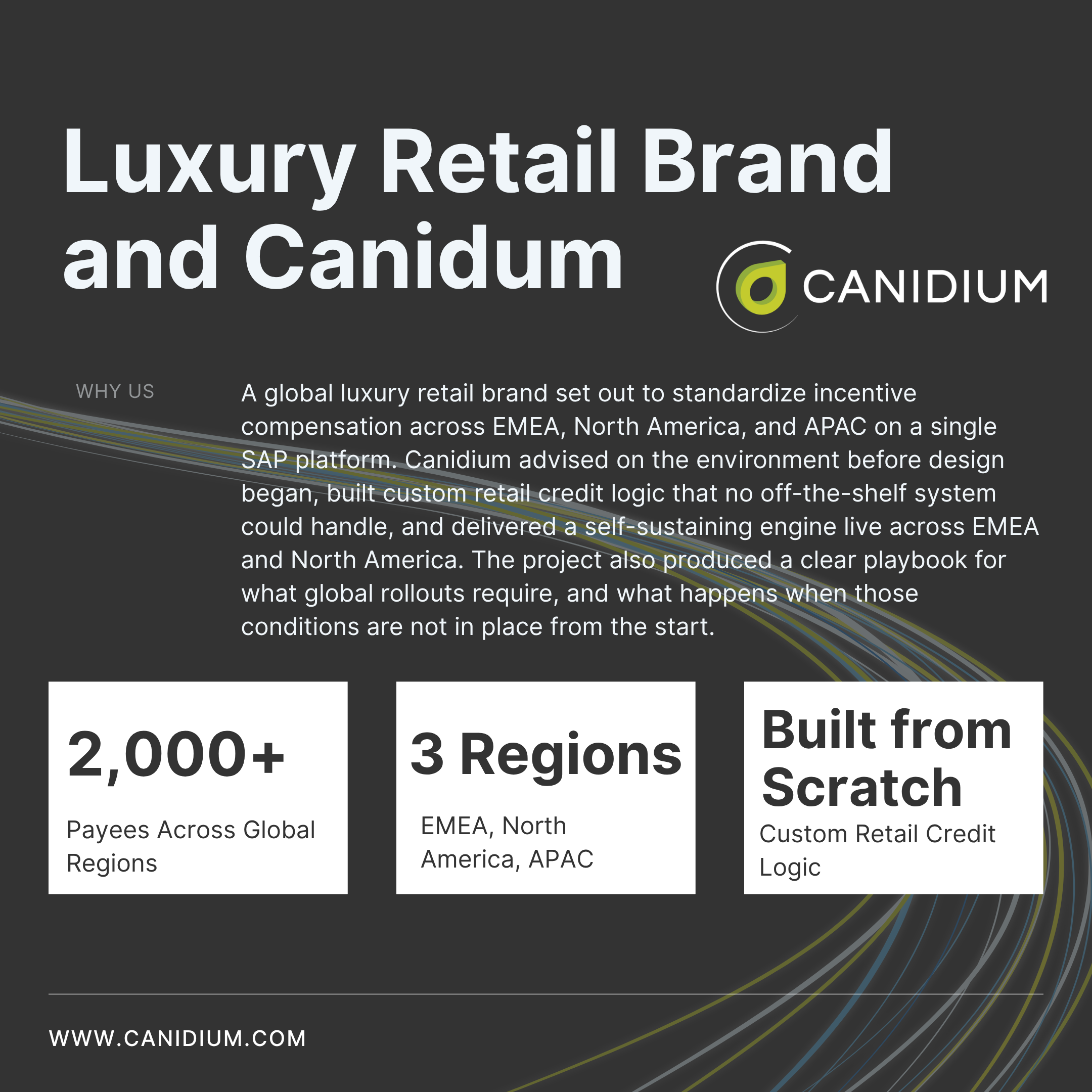

When a global luxury retail brand sets out to standardize how it pays its salesforce across three continents, the hardest problems are rarely the ones anyone drew on the whiteboard at the start. This brand, part of a larger corporate group, wanted to move off a legacy compensation environment and onto a single centralized SAP platform that could calculate incentive compensation consistently across EMEA, North America, and APAC. The aim was standardization, one common engine and one common set of rules for a business that had been running on something far less unified. Canidium was brought in to design and build it.
The vision was sound. Some of the conditions it depended on, though, were set before Canidium ever arrived, and those constraints went on to shape the entire project. The most consequential of them was a decision about the environment itself.
The brand was required to share a single SAP instance with a larger affiliate brand inside the same corporate group. Canidium advised against it in clear terms. A shared instance would leave the smaller brand subject to the larger one's decisions, schedules, and operational priorities, so the recommendation was a dedicated instance the brand could control on its own terms. That advice went unheeded, because the choice came down to two things the client was unwilling to give up: keeping costs down, and letting an executive at the parent company log in to see all the data in one place. The team showed that centralized visibility could be achieved other ways without the operational entanglement, but the shared instance stayed.
Canidium advised against the shared instance, but the decision had already been made on cost before the build began.
That single choice rippled through everything that followed. Because the larger affiliate's priorities centered on North America, its schedules and operational decisions set the tempo, and the luxury brand's core team had to work around them from start to finish. Rather than fight a constraint the client had chosen, Canidium designed the architecture to limit the brand's exposure to the affiliate's decisions wherever it could, a defensive posture that influenced one technical choice after another.
Underneath the environmental constraints sat a genuinely hard technical problem, and solving it is one of the things the team is proudest of. Luxury retail compensation does not fit any standard SAP template. Picture a common scenario: a customer in New York buys a bag that is physically pulled from a store in Miami. Crediting that sale correctly, across the right regions, locations, and sales associates, calls for logic that does not exist out of the box. Canidium built it from scratch, creating a custom crediting engine that could attribute commissions across cross-region sales, store-to-store transfers, and multi-location scenarios, designed to scale as the brand's footprint grew.
A bag bought in New York but pulled from a Miami store still has to credit correctly, and no standard SAP template handles that.
Europe added a layer of its own. Treating EMEA as a single market was never an option, because hiring rules, termination laws, and pay proration requirements shift from one country to the next, and every one of those variations had to be identified and built into the system. What looked from a distance like one region turned out in practice to be a collection of distinct regulatory environments, each of which had to be handled correctly.
Coordinating all of it across three continents put real pressure on the team's planning. With stakeholders spread across barely overlapping time zones, gathering requirements and running testing meant working within availability windows that rarely lined up, which made disciplined scheduling essential at every stage of the build.
Canidium also built for the day it would step away. Working alongside the brand's internal department, the team supported the documentation of the system and the creation of training artifacts, so the architecture would be fully understood and self-sustaining after go-live instead of dependent on the implementation team. Whatever happened next, the client would own what had been built.
The results were real, and so were their limits. In EMEA and North America, the system went live and was put to work, with EMEA launching in late 2021 or early 2022. It calculated commissions correctly and consistently across regional nuances, drew on reliable data feeds, and did so for a payee population estimated at more than 2,000 across the global regions. The complex retail logic held up against real-world scenarios that no off-the-shelf system could have handled, and the documentation and knowledge transfer left the brand with a system it could operate on its own.
APAC is where the story turns instructive. The build and deployment for the region were completed, but the rollout struggled to gain traction with users. That difficulty traced back to coordination gaps that had been present since early in the project, along with a lack of top-down enforcement from regional leadership. Without executive pressure to move off the old manual approach, teams quietly stayed on their spreadsheets even after the system was ready for them, so the technology worked while the adoption it was meant to drive never fully arrived.
Where adoption lagged, the missing ingredient was executive enforcement rather than engineering.
Taken as a whole, the project succeeded in the terms it could control. Canidium delivered the full scope on a sound build and kept a strong relationship with the client team from beginning to end. It did not launch the way everyone had hoped, and the reasons why are exactly what make the project worth studying for any organization planning a rollout of its own.
- Successful go-live across EMEA and North America, with EMEA launching in late 2021 or early 2022
- 2,000+ payees supported with accurate, consistent commission calculations across regions
- Custom retail logic built from scratch covering cross-region sales, store-to-store transfers, and multi-location crediting
- Reliable data integrity across diverse regional requirements
- A self-sustaining system with documentation and knowledge transfer complete
What This Project Teaches Every Global Client
Some of the most valuable lessons from this engagement came from the constraints the client chose rather than the work Canidium delivered. For any organization planning a multi-region compensation rollout, three of them stand out.
- Engage your implementation partner early: Bringing expert input in before budgets and licenses are finalized can head off constraints like a shared instance and save months of friction downstream. The best time to plan a global rollout is before the contracts are signed.
- Plan for adoption as deliberately as you plan for go-live: A technically successful build does not guarantee that people will use it. Global rollouts need executive sponsorship and top-down enforcement in every region, or manual spreadsheets will outlive the launch.
- Treat every region as its own implementation: A multi-market region cannot be handled as a single entity. EMEA and APAC each require dedicated planning, localized expertise, and their own stakeholder alignment strategy.
FAQ: Global Compensation Standardization in Luxury Retail
1. Who was the client and what were they trying to accomplish?
The client is a prominent global luxury retail brand operating under a larger corporate group. They set out to move from a legacy compensation environment to a centralized SAP platform, with the goal of standardizing their incentive compensation plans across three major regions: EMEA, North America, and APAC. Canidium was brought in to design and build that centralized compensation engine.
2. What made this project so complex?
- A shared SAP instance: The brand was required to share an SAP instance with a larger affiliate brand in the same group, which left it subject to that brand's decisions and schedules.
- Multi-continent coordination: Aligning EMEA, North America, and APAC across barely overlapping time zones made requirements gathering and testing difficult.
- Complex retail compensation logic: Store-to-store transfers and cross-region sales required custom crediting logic with no standard SAP equivalent.
- Regional diversity: Each region carried distinct requirements, from EMEA's country-by-country regulations to APAC's coordination challenges.
3. Why did Canidium advise against the shared SAP instance?
A shared instance meant the luxury brand would be subject to the decisions, schedules, and operational priorities of a larger affiliate brand whose focus was centered on North America. Canidium recommended a dedicated instance the brand could control directly. The client proceeded with sharing anyway, driven by cost concerns and a desire to give an executive at the parent company a single view of all the data. Canidium pointed out that centralized visibility could be achieved through other means, then designed the architecture to limit the brand's exposure to the affiliate's decisions as much as possible.
4. What technical barriers did Canidium overcome?
- Custom retail credit logic: No standard SAP template accounts for store-to-store transfer scenarios in luxury retail, so Canidium built cross-region sales, store-to-store transfers, and multi-location crediting from scratch.
- EMEA regulatory complexity: Hiring rules, termination laws, and pay proration requirements vary country by country across Europe, and each had to be identified and built into the system.
- Time zone coordination: With stakeholders spread across three continents, coordinating requirements and testing demanded exceptional planning and flexibility.
5. What solutions did Canidium deliver?
- Trusted advisor guidance: Canidium presented the benefits and drawbacks of the shared instance clearly so the client understood the risks before proceeding.
- Custom global build: The team built a reliable SAP system capable of calculating unique, complex retail compensation plans across multiple world regions.
- Collaborative knowledge transfer: Canidium supported the client's internal department in documenting the system and creating training artifacts for self-sustaining operation.
- Multi-region rollout: The solution was successfully deployed to EMEA and North America, establishing a consistent calculation engine.
6. What were the results?
- Successful go-live across EMEA and North America, with EMEA live in late 2021 or early 2022
- Accurate, consistent commission calculations for an estimated 2,000+ payees across regions
- Custom retail logic covering real-world scenarios no off-the-shelf system could handle
- Reliable data feeds and strong data integrity despite regional differences
- A self-sustaining system, with documentation and knowledge transfer complete
7. What happened with the APAC region?
The build and deployment for APAC were completed, but the region struggled to reach full user adoption. The coordination difficulties that had been present from early in the project, combined with a lack of top-down enforcement from regional leadership, meant that teams tended to stay on their existing manual processes even once the system was ready. It is a clear illustration of a wider truth about global rollouts: technical success does not guarantee adoption without executive sponsorship behind it.
8. What technologies were used?
- SAP (centralized compensation platform)
- SAP Incentive Management
9. What should organizations planning a global rollout take away from this project?
- Engage your implementation partner before budgets and licenses are finalized, so environmental choices like a shared instance can be evaluated early.
- Plan for user adoption as carefully as the technical build, with executive sponsorship and enforcement in every region.
- Treat each multi-market region as its own implementation, with localized planning and dedicated stakeholder alignment.
- Lean on a partner who will act as a trusted advisor, presenting the real tradeoffs of each decision rather than simply executing requests.
Planning a global compensation rollout?
The earlier the right partner is at the table, the more friction you can avoid once budgets, licenses, and environments are locked in. Canidium helps global organizations plan and build multi-region compensation systems that account for regional complexity and are designed for adoption from day one. Talk with an expert about what a global rollout could look like for your organization.