

Implementing a compensation plan across multiple continents has been called an impossible task, and the description is not far off. Coordinating across time zones, legal jurisdictions, and local cultures introduces a level of complexity that can overwhelm even a well-resourced team. The part that most often decides the outcome, though, is the part organizations plan for least, and it has surprisingly little to do with the software they choose.
Global rollouts rarely succeed or fail on the technology alone. They succeed or fail on whether the organization is genuinely ready to adopt the system once it has been built. A recent engagement with a global luxury retail brand shows why, and it offers a practical guide to the factors that separate a smooth multinational implementation from one that quietly stalls.
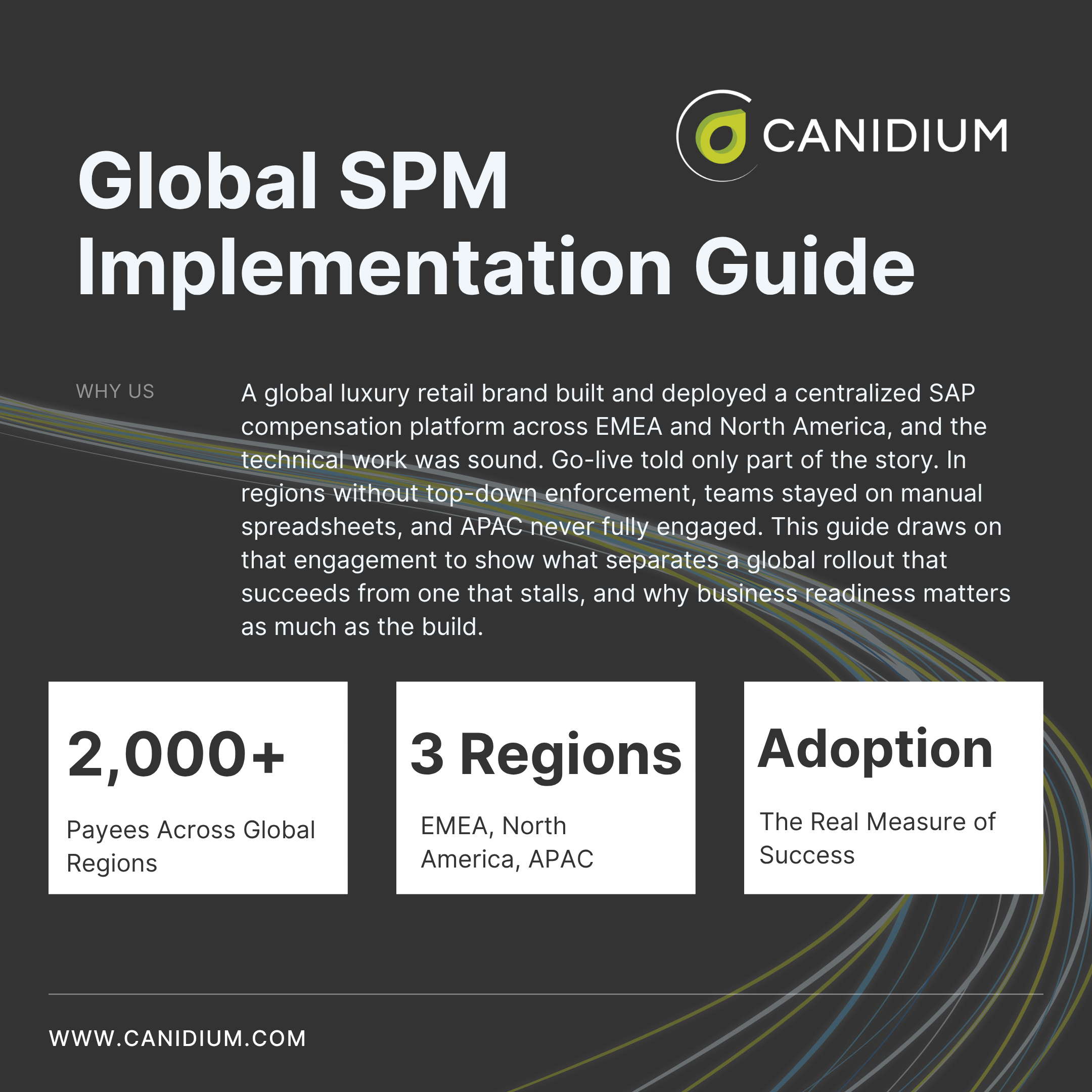
The brand, part of a larger corporate group, set out to standardize its incentive compensation across EMEA, North America, and APAC on a single centralized SAP platform. Working with Canidium, the brand successfully built and deployed that platform for more than 2,000 payees across the global regions, with a system that calculated complex retail compensation correctly and consistently. In EMEA and North America, the rollout took hold and the technical foundation proved sound. What happened in the regions where it did not take hold is the part worth studying.
Global rollouts rarely succeed or fail on the technology; they succeed or fail on whether the organization is ready to adopt what gets built.
The Gap Between Go-Live and Adoption
A technical go-live is a milestone worth marking, but on its own it does not amount to success. Adoption is the goal, and a system that regional teams decline to use has not delivered on its promise regardless of how clean the build was. This is exactly where the luxury retail rollout ran into trouble. In the regions where leadership actively drove the change, the system took hold, and in the regions where leadership did not, teams quietly stayed on the manual spreadsheets they already knew.
APAC was the clearest example. The region had never been fully aligned with the global rollout strategy, and poor communication and missed coordination left it behind before the project even launched. The build and deployment were completed, yet without top-down enforcement from regional leadership, adoption never materialized. The technology was ready while the organization, in that region, was not.
The takeaway is straightforward. Technical success does not guarantee adoption, and the gap between the two comes down to business readiness, which is something an organization has to build deliberately rather than assume will follow from a working system.
Where Global Rollouts Break Down
Certain patterns show up again and again in global implementations that struggle, and most of them can be avoided with the right planning up front. Five are worth watching for in particular.
- The shared instance trap: Sharing a platform instance with another brand or business unit creates roommate friction, where one team's schedule and priorities inevitably affect the other. The luxury retail brand lived this firsthand, sharing an SAP instance with a larger affiliate whose North America-centric priorities set the tempo for everyone else.
- Rigid rapid deployment models: Pre-packaged, out-of-the-box implementation models frequently fail to account for the real complexity of global retail, healthcare, or financial services. Forcing a business into a pre-built box tends to produce workarounds first and abandonment later.
- Late-stage consulting: When strategic advisors are brought in after licenses are signed and budgets are locked, they inherit constraints that could have been avoided entirely. Much of what limited the luxury retail rollout had been decided before the implementation team ever arrived.
- Fragmented business and IT alignment: Implementation delays often trace back to silos between business stakeholders and IT, with each side working from different timelines and priorities and no shared roadmap between them.
- Ignoring user adoption: A technical go-live means little when regional teams are disengaged or face no real expectation to use the system. Adoption has to be planned for as deliberately as the build itself.
Sharing a platform with another brand creates roommate friction, where one team's schedule and priorities inevitably affect the other.
A Framework for Business Readiness
Avoiding those landmines calls for a deliberate approach to business readiness, one that treats adoption as a core deliverable rather than a fortunate byproduct of a good build. A handful of principles carry most of the weight.
- Enforce before you launch: Regional adoption depends on top-down mandates far more than on training alone. Every region needs an executive sponsor who is accountable for migrating away from manual processes before go-live rather than after it.
- Align business and IT early: Fragmented decision-making between business stakeholders and IT is among the most common causes of implementation delay. Both sides should be operating from a shared roadmap before the project starts, not negotiating one midway through.
- Build reports users will trust: A compensation system only earns adoption when the people paid by it believe the numbers. Reports need to be tailored to each user group, with transparent checkpoints that show exactly how a given calculation was reached.
- Treat each region as its own workstream: EMEA and APAC each contain many distinct markets, and treating either as a single entity is a mistake. Each region needs its own stakeholder alignment, compliance review, and adoption strategy, scoped and resourced accordingly. EMEA alone spans widely varying laws on hiring, terminations, and paid proration, all of which have to be built into the system.
- Plan change management as a deliverable: Change management belongs on the project plan from the beginning, owned and resourced like any other deliverable rather than treated as something to sort out once the build is finished.
Two foundational elements support all of this. The first is architectural leadership, because complexity at global scale calls for a dedicated solution architect who can keep the system flexible enough to grow while keeping it maintainable. The second is testing rigor. High-stakes global rollouts demand exhaustive validation, sometimes exceeding 800 test cases, to confirm that data from disparate legacy systems flows accurately into the new engine before anyone comes to depend on it.
When a Project Has Already Stalled
Not every organization reading this is standing at the start of a rollout. Some are in the middle of one that has bogged down, and for them the most valuable move is often the hardest one to accept.
- Adopt a reset mindset: When a project has been stuck for months or years, it can be worth wiping the environment and restarting from requirements rather than continuing to force-fit the business into whatever has already been built.
- Build a trusted advisor partnership: Success tends to come from a three-way partnership between the client, the software provider, and a strategic implementer willing to challenge misconceptions and advocate for the best long-term solution even when that is the harder conversation to have.
- Evolve with agile methods: Agile approaches gather continuous feedback and let the system adjust to the client's needs, rather than making the client bend to the tool.
With the luxury retail brand, Canidium played exactly that trusted advisor role. The team advised against the shared instance before work began, making sure the client understood the risks even though the decision could not be changed, and supported the internal documentation and training that left the organization able to operate and sustain the system on its own. The willingness to have the harder conversation, and to advocate for the better long-term outcome, is what distinguishes a strategic implementer from a vendor that simply executes the request in front of it.
FAQ: Global SPM Implementation and Business Readiness
1. What does business readiness mean in a global SPM rollout?
Business readiness is the organization's capacity to actually adopt and use a new compensation system once it goes live. It covers executive sponsorship, alignment between business and IT, trust in the system's reporting, and a clear plan for moving each region off its old processes. A rollout can be technically flawless and still fall short if business readiness is missing, because the people expected to use the system will default to what they already know.
2. Why isn't a technical go-live enough to call a project a success?
Go-live confirms that the system works, but it says nothing about whether people use it. In the luxury retail engagement, the platform was built and deployed successfully, yet in regions without top-down enforcement, teams stayed on manual spreadsheets. A system that is live but unused has not delivered its value, which is why adoption, rather than deployment, is the real measure of success.
3. What is the shared instance trap?
A shared instance trap happens when an organization shares a single platform instance with another brand or business unit, often to save cost or centralize visibility. The result is roommate friction, where the larger or more dominant party's schedules and priorities constrain everyone else. In the luxury retail case, sharing an SAP instance with a larger affiliate meant the brand was subject to that affiliate's North America-centric decisions throughout the project.
4. How do you drive regional adoption in a global rollout?
- Secure executive sponsorship: Every region needs a leader accountable for the transition, because adoption depends on top-down mandates more than on training alone.
- Set the expectation before go-live: Regions should be committed to leaving manual processes behind before launch rather than after it.
- Earn trust through reporting: Tailored, transparent reports that show how calculations were reached give users a reason to believe the system.
- Plan change management deliberately: Treat adoption as a resourced deliverable with a clear owner, not as an afterthought.
5. Why should you involve an implementation partner early?
Bringing a strategic implementer in after licenses are signed and budgets are locked means they inherit constraints that could have been avoided. Early involvement lets a partner weigh in on foundational choices, like whether to share an instance or how to structure regional rollouts, before those decisions harden. Much of what limited the luxury retail rollout had been decided before Canidium arrived, which is a common and preventable pattern.
6. What should you do if a global implementation has already stalled?
When a project has been stuck for months or years, the most valuable move is often a reset. That means wiping the environment and restarting from requirements rather than continuing to force the business into what has already been built. Pairing that reset with a trusted advisor partnership and agile delivery, which gathers continuous feedback and adapts the system to the business, gives a stalled initiative the best chance of recovery.
7. What role does reporting play in adoption?
Reporting is central to whether a compensation system is believed and therefore used. People paid by the system need to see clear, transparent checkpoints that show exactly how their numbers were calculated, and those reports need to be tailored to each user group rather than delivered as a one-size-fits-all output. Trustworthy reporting turns a system users are skeptical of into one they rely on.
8. How should you approach a multi-market region like EMEA?
A region like EMEA cannot be treated as a single entity. It spans many countries with widely varying laws on hiring, terminations, and paid proration, and each of those variations has to be identified and built into the system. The same holds for APAC. Each region deserves its own stakeholder alignment, compliance review, and adoption strategy, scoped and resourced as its own workstream rather than folded into a single global plan.
9. Why choose Canidium for a global SPM implementation?
- Experience navigating the real complexity of multinational rollouts across regions, regulations, and time zones.
- A trusted advisor approach that surfaces risks and challenges assumptions before decisions harden, even when it means a harder conversation.
- A focus on business readiness and adoption, treating change management and executive enforcement as core parts of the work.
- Deep technical capability to build complex, region-specific compensation logic that off-the-shelf models cannot handle.
- A partnership mindset that leaves clients able to operate and sustain their own systems after go-live.
Planning a global rollout, or working to rescue one?
The earlier the right partner is at the table, the more of these landmines you can avoid, and even a stalled project can often be reset and recovered. Canidium helps global organizations plan, build, and adopt multi-region compensation systems designed for business readiness from day one. Talk with an expert about what a successful global rollout could look like for your organization.