

When raw material costs swing wildly from one month to the next, a pricing process built for stability stops working. That was the reality facing Ventura Foods, a major food and beverage manufacturer caught in what their own team described as a perfect storm. Supply chain disruptions were stretching delivery times, while fuel costs drove transportation expenses sharply higher; at the same time, shifting weather patterns and changes in foreign trade were making crop yields and raw material availability genuinely unpredictable.
The numbers behind that storm were not abstract. The USDA was projecting a 3.7% increase in food-away-from-home prices, with a forecast volatility range running from 2.6% all the way to 4.9%. For a manufacturer operating on the margins that define the food industry, that kind of swing is the difference between a profitable year and a painful one. Ventura Foods needed a way to see cost changes coming and adjust pricing quickly enough to stay ahead of them, rather than reacting weeks after the damage was already done.
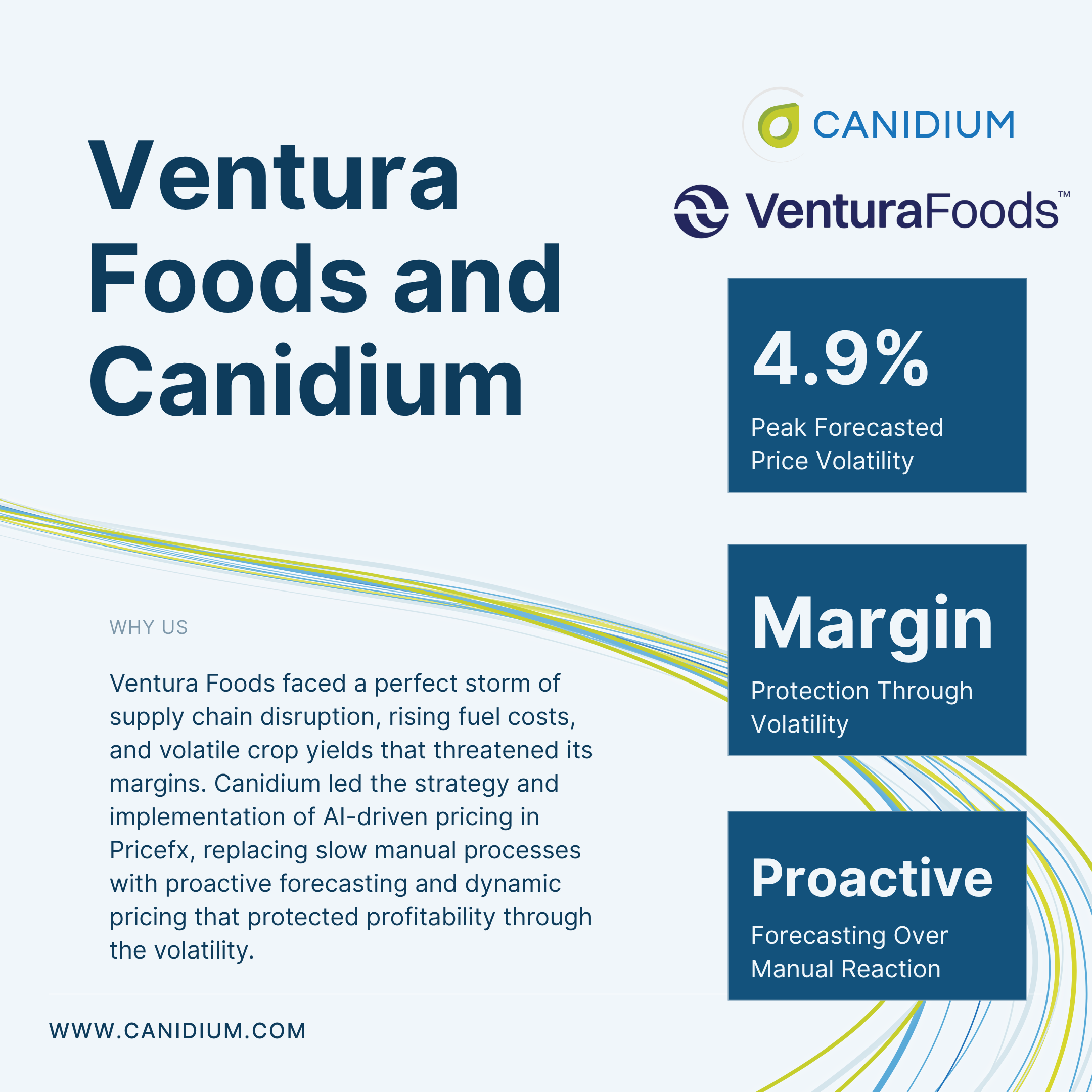
A perfect storm of supply chain delays, rising fuel costs, and volatile crop yields, against a USDA forecast swinging as wide as 4.9%.
The pressure showed up in specific, painful ways. A disruption in egg supply exposed just how vulnerable the company was to single-source commodities, and every new flavor or product launch added to pricing complexity, requiring fresh market research and validation. Underneath those individual shocks sat a deeper structural problem, because the pricing team was managing quotes, contracts, and price lists almost entirely by hand in a market that was moving far too fast for manual work to keep up. Rising transportation and compliance costs only sharpened the risk, threatening margins that the existing process had no reliable way to protect.
Ventura Foods turned to Pricefx for the pricing engine and to Canidium to lead the strategy, implementation, and go-to-market work that would make it stick. What the partnership built gave the company a way to hold its pricing discipline steady, even while the market around it refused to sit still.
The foundation of the work was a shift from manual reaction to data-driven anticipation. Canidium implemented AI-driven pricing logic in Pricefx that automated the organization of price lists and optimized pricing strategies to defend margins even when costs spiked. The pricing team had been spending much of its time simply keeping lists current, and moving that maintenance into an automated system freed them to spend their energy on strategy instead of upkeep.
AI-driven pricing logic took over the list maintenance that had been swallowing the team's time, so they could focus on strategy.
Quoting and contracts came next. The existing process was slow and error-prone in a way that hurt most precisely when speed mattered, so Canidium deployed tools that simplified quoting and let the team close deals faster and more accurately. The improvement in dealing with cycles was immediate, and it compounded over time as the team grew comfortable working inside the new system.
Forecasting was where the strategy really came together. Rather than waiting for a commodity shock to hit and then scrambling to respond, Ventura Foods could now use real-time analytics and AI-driven insight to predict where trends were heading and adjust before a spike landed. The egg supply problem that had caught them off guard became the model for a broader approach to diversified sourcing logic, reducing the company's exposure to any single supplier and giving the pricing strategy room to flex when one input suddenly became scarce or expensive.
None of this would have mattered if the people expected to use it pushed back, which is why change management ran alongside the technical work rather than after it. Canidium executed a structured program of training, clear communication, and documentation designed to bring the pricing team along and head off the resistance that so often stalls a new system. By the time the tools went live, the people who depended on them already understood how to use them and why they mattered.
Change management ran alongside the build, not after it, so the team was ready the day the tools went live.
The results showed up across the parts of the business that the volatility had threatened most. Diversified sourcing logic and dynamic pricing adjustments gave Ventura Foods real resilience against the supply shocks that had previously left them exposed, and the egg-supply vulnerability that had once been a liability became a solved problem. On the operational side, automating the administrative burden gave the pricing team its time back, letting a group that had been buried in list maintenance turn its attention to the strategic work that actually moves margins.
Margin protection was the outcome that mattered most to the bottom line. Through proactive forecasting and the ability to adjust pricing quickly, Ventura Foods absorbed the impact of cost spikes that would have eaten into profitability under the old manual approach. Deals moved faster and landed more accurately thanks to the automated contract and quoting tools, which meant the company could respond to customers at the speed a volatile market demands. With Bill McCullough, the company's Senior VP of Revenue Management, championing the approach internally, the new way of working took hold across the organization rather than staying confined to a single team.
- Supply chain resilience strengthened through diversified sourcing and dynamic pricing, with single-source commodity risk addressed directly
- Workload efficiency gained by automating price list maintenance, freeing the pricing team to focus on strategy
- Margins protected through proactive forecasting and agile pricing adjustments during cost spikes
- Faster, more accurate deal cycles from streamlined, automated quoting and contract tools
FAQ: Ventura Foods, Canidium, and Pricefx
1. Who is Ventura Foods, and what brought them to Canidium?
Ventura Foods is a major food and beverage manufacturer that found itself caught in a period of severe market volatility, with raw material costs, fuel prices, and regulatory compliance expenses all swinging unpredictably at once. Their existing pricing process relied heavily on manual work that could not react quickly enough to protect margins in that environment. Ventura Foods brought in Pricefx as the pricing platform and Canidium to lead the strategy, implementation, and go-to-market effort needed to make the transformation succeed.
2. What were the biggest challenges Ventura Foods faced?
- Commodity price shocks: Supply disruptions, such as a shortage in egg supply, exposed the risks of relying on single-source commodities and made dynamic pricing a necessity.
- Product complexity: Each new flavor and product launch added pricing complexity that required market research and validation to get right.
- Operational strain: The pricing team was overwhelmed by the manual effort of quoting, managing contracts, and maintaining price lists in a fast-moving market.
- Margin erosion risk: Rising transportation and compliance costs threatened profitability whenever pricing could not keep pace with the changes.
3. What technical barriers did Canidium need to solve?
- Data complexity: Managing price volatility across diverse customer segments called for sophisticated data handling that the legacy approach could not provide.
- Supply chain integration: The system needed to account for real-time variables like weather effects on crop yields and shifts in foreign trade.
- Legacy process constraints: Existing manual workflows for price list management and quoting were simply too slow to react when the market spiked.
4. What solutions did Canidium implement?
- AI-driven pricing logic: Automated the organization of price lists and optimized pricing strategies to protect margins and maximize revenue even during cost spikes.
- Streamlined quoting and contracts: Simplified the quoting process so the team could put together quicker, more accurate deals.
- Proactive forecasting: Enabled data-driven decisions that let the team anticipate trends and mitigate the risk from external changes like weather and regulation.
- Diversified sourcing logic: Reduced the company's vulnerability to single-supplier disruptions, with the egg supply problem as the model for the broader approach.
- Change management program: Delivered structured training, clear communication, and documentation to ensure the new tools were adopted smoothly.
5. What were the results?
- Greater supply chain resilience through diversified sourcing and dynamic pricing
- Reduced manual administrative burden, freeing the pricing team to focus on strategy
- Margins protected against cost spikes through forecasting and agile pricing
- Faster, more accurate deal cycles from automated quoting and contract tools
6. What technologies were used?
- Pricefx (pricing software for automation and optimization)
- AI and real-time analytics for forecasting and pricing insight
- Canidium strategy, implementation, and go-to-market services
7. How did AI and forecasting change the way Ventura Foods handles volatility?
The old approach was fundamentally reactive, with the team adjusting prices after a cost change had already worked its way through the business. AI-driven forecasting flipped that sequence by giving Ventura Foods the ability to see trends developing and adjust pricing before a spike arrived. When a commodity like eggs came under pressure, the company could lean on diversified sourcing logic and dynamic pricing to absorb the shock rather than passing every cost increase straight through to its margins. The result was a pricing function that could anticipate rather than chase.
8. Why was change management such an important part of this project?
A pricing transformation only delivers value if the people responsible for pricing actually use the new tools. Ventura Foods and Canidium recognized that moving a team off familiar manual processes can generate real internal resistance, so the rollout included a deliberate program of training, communication, and documentation from the start. That investment in adoption is a large part of why the new system took hold quickly, and why the efficiency and margin benefits materialized instead of stalling out against old habits.
9. Why should food and beverage manufacturers facing volatility choose Canidium?
- Deep Pricefx expertise paired with pricing strategy knowledge that extends well beyond platform configuration.
- Experience building AI-driven forecasting and dynamic pricing that holds up under real market volatility.
- A go-to-market and implementation approach that connects pricing technology to the commercial outcomes that matter.
- Structured change management that drives adoption and protects the return on the investment.
- A track record of helping manufacturers protect margins and strengthen resilience in unstable conditions.
Is market volatility eroding your margins?
Canidium helps manufacturers replace slow, manual pricing with AI-driven forecasting and dynamic strategies that protect margins when costs swing. Talk with an expert about what a Pricefx implementation could do for your business.